 Presence.
Featured on SnR’s current websiteOne Night
Explore media coverage ↗One Night
in Chicago.
Beyond the headline. Into the human work of showing up.
Quick Exit leaves this site.
It does not erase browser history.
Standing with youth and families.
From crisis to continuing care.
872.702.1313A person. A next step. A way forward.
A new chapter in youth support · Ages 11–24
What happened matters. Your future still belongs to you. Explore SnR’s planned youth recovery initiative.
Families should not disappear between institutions just because each system holds only one piece of the crisis.
Support belongs in the places where life is happening—not only on the pages of a referral.
Explore how support can continue across the places and decisions that follow violence. There is no single timetable for a family’s recovery.
A flexible map of support, not stages of grief. People can enter, revisit, or skip parts of this pathway; care can overlap.
The person who was hurt. The family waiting. The neighbor who heard it. The child who saw it. The worker returning to the counter. There is room to ask for support.
A citywide commitment, grounded in the people, relationships, and realities of each neighborhood.
Books, short videos, practical guides, and community events. Choose what fits today; leave the rest for another day.
“I do not have to
carry every part of
today at once.”
Beyond the headline. Into the human work of showing up.
FBI Chicago named Rev. Dr. Donovan E. Price Sr. a recipient of its Director’s Community Leadership Award.
Read the FBI announcement ↗Talk with SnR now, or let us help you find a next step. You do not need to tell your story or answer questions to reach us.
Immediate danger or a medical emergency? Call 911. SnR is not an emergency dispatch service.
Immediate help · Chicago / Cook
Orders of protection, shelter referrals and an advocate. Start here without answering questions.
If you were told your loved one is at the Cook County Medical Examiner’s Office, call Intake before traveling. After an overnight death, make this a first call the following day at opening; check the different public-office and identification hours in the guide. Follow any earlier instructions from staff. Not every case requires an in-person visit.
Find a starting point / entirely optional
Choose what fits today to continue. You can change your choice, explore another perspective, or skip this step. These are starting points—not eligibility rules.
Choose one place to begin. You can come back to the other needs.
SnR can discuss possible support, resources and appropriate referrals. Availability and eligibility vary. These choices do not dispatch anyone, submit a service request, or guarantee funding, clinical care or a legal outcome.
Your story stays yours. This guide does not ask for a name, location, contact details or case information. Choices are kept only in this page’s memory—not sent to SnR, saved in browser storage, or added to the web address. Reloading clears them.
Cook County Victim Services may be able to discuss relocation after a violent-crime case is charged. This is case-specific, not general housing assistance or guaranteed SnR funding.
No questions are required to use these links. Immediate danger or medical emergency: call 911. Outside provider source checked September 16, 2026.
Start with what you need most. SnR can discuss the situation, identify possible support, and help you understand the next steps. The response depends on the needs, available resources, and appropriate services.
Choose a starting point, then use “Explore another perspective” to look at another. Your choice does not restrict which resources you can read or what you can ask SnR about.
No. Begin with the information you are comfortable sharing. Do not send Social Security numbers, medical records, case files, or sensitive location information through a general website form.
Yes—you can reach out about your own experience, too. Choose “Responders, clergy & community helpers,” then “I need support myself,” or call SnR directly.
No. A website visit, email, or general inquiry does not dispatch police, an ambulance, or an SnR responder. Call 911 when there is immediate danger or a medical emergency.
Browsing, filtering resources and choosing a guide answer do not send a request or dispatch anyone. You can call 872.702.1313 to discuss possible support. Availability depends on the situation and resources. General email is not an emergency channel; do not send sensitive records or private addresses through it.
Choose a service to read about, or contact SnR directly. These pages explain the same work described throughout the site.
Solutions and Resources supports young people and families affected by violence and traumatic loss, connecting immediate presence with practical advocacy, family stabilization and continuing care across Chicago.
Supporting young people and their families affected by violence and traumatic loss is an established part of Solutions and Resources’ work in Chicago.
SnR connects crisis response, grief support, family stabilization, safety planning, referrals and follow-up. Caregiver involvement helps keep the young person’s needs at the center of support.
A new chapter in youth support · Ages 11–24
What happened matters. Your future still belongs to you. Explore SnR’s planned youth recovery initiative.
These are places where support can meet a person—not milestones they must complete. A funeral applies only after a death; justice-system processes and healing can move on different timelines.
In the first minutes after violence, familiar surroundings can feel unfamiliar. Someone may be injured; relatives may be searching for answers; neighbors may have heard or witnessed the incident. Emergency responders handle immediate safety and medical needs. The human need for clear information, privacy, and a steady presence sits alongside that response.
Healing does not have to wait until the scene is cleared. Respectful first contact can help someone begin to regain orientation and choice. The purpose is not to make the moment feel “okay,” but to help a person face the next decision with support.
The circle can include a witness at a bus stop, a child watching from a window, residents unable to enter their home, or employees sheltering inside a business. They may need their own check-in or referral—not access to the family’s private information.
Prioritize immediate safety and medical attention. For support beyond emergency response, contact SnR. A website selection does not dispatch a responder.
Hospital care can involve uncertainty, treatment decisions, changing information, and long periods of waiting. An injured person may be focused on recovery while relatives balance work, children, travel, and communication. An advocate’s role is to support the human experience around medical care—not replace the clinical team or promise an outcome.
Lasting support matters here: the person is more than an injury, and discharge is not the end of the impact. Support aims to make the transition from treatment to everyday life less fragmented, with the survivor’s priorities still at the center.
Family caregivers, partners, siblings, and chosen family may also need support. Friends, neighbors, and employers can assist with agreed practical needs without expecting medical details. Hospital updates belong to the patient and their authorized contacts.
Ask the treating team about medical care and discharge plans. Contact SnR to discuss accompaniment, resource navigation, or support for the household.
The first days after an incident may bring funeral questions, changed routines, paperwork, transport needs, and difficulty concentrating. There may also be uncertainty about returning to a home, school, workplace, or block. Not every affected person is bereaved, and people do not have to share the same experience to need help.
Practical support creates room for recovery. A clear next step can reduce the number of problems a person must handle at once. It does not erase what happened; it helps prevent the aftermath from becoming a series of disconnected crises.
Neighbors and business staff may be returning to a place associated with the incident. A block contact can help share verified support information without circulating images, rumors, names, or details the family has not agreed to share.
Start with the concern making today hardest. You do not need to solve the entire aftermath before asking for help.
For a family facing a death, memorial decisions can arrive before they have had time to absorb the loss. Traditions, beliefs, relationships, costs, and safety concerns may all matter. This part of the pathway applies only when someone has died; it is not a required step for every survivor.
A funeral or memorial can create space for remembrance, but it is not a deadline for grief and does not require “closure.” Care should remain available to discuss after the gathering ends, including anniversaries and difficult dates.
Classmates, neighbors, coworkers, and regular customers may also be grieving. Their wish to remember should not override the family’s wishes. Separate, consent-aware opportunities for community reflection may be more appropriate than making every need part of one event.
Contact SnR to discuss bereavement or memorial support. Participation, prayer, public speaking, and sharing a story should remain choices.
Investigations, court dates, notifications, and assistance applications can unfold long after the incident. People may want information, accompaniment, help identifying the correct office, or simply a clearer explanation of a process. The case’s progress and a person’s healing are not the same thing.
Advocacy aims to keep people from feeling lost between institutions. It supports participation and informed choices where possible; it cannot guarantee an arrest, a decision, financial eligibility, or a legal result. Healing does not have to wait for a case to end.
Witnesses, affected employees, and neighbors may have their own questions or fears. They should be directed to appropriate official contacts and support, not asked to post case details, identify someone online, or conduct a community investigation.
Use official case contacts for legal or investigative questions. SnR can discuss navigation and accompaniment; this site is not legal advice.
Stability can mean something different for each household: a workable routine, support for children, connection to counseling, or help navigating work and housing concerns. Needs can change over time. A person may revisit earlier parts of this pathway while rebuilding practical support.
Stabilization is not a demand to return to who someone was before. It is the work of creating a more dependable daily foundation, so there is room for rest, relationships, grief, and longer-term recovery. Progress may be uneven.
A neighborhood’s recovery also involves the places people depend on: schools, shops, faith communities, and public spaces. Employers can ask staff what support would help; block leaders can discuss voluntary check-ins and practical help without requesting private case histories.
Contact SnR to discuss a changing need or a difficult handoff. Business property, insurance, employment, and legal concerns may need separate specialist assistance.
Healing is not forgetting, a fixed sequence, or a date on a calendar. People may need grief support, trauma-focused professional care, trusted relationships, spiritual accompaniment, or ordinary moments that are not about the incident. What feels useful can change.
This is the purpose running through the whole continuum—not a reward at its end. Support should help people find choices and connections that fit their lives. Returning for help, feeling grief again, or declining an activity does not mean someone has failed.
Healing can include the whole block: children who witnessed violence, neighbors who carry the memory, coworkers, and business owners rebuilding a sense of connection. Community gatherings should be voluntary and accessible, and must not replace individual care when that is needed.
Explore the resource library or current organizer listings, contact SnR, or simply take a moment. There is no requirement to choose every part of the pathway.
Practice context: NCTSN / National Center for PTSD, Psychological First Aid. These descriptions explain possible support, not a treatment protocol or an independently evaluated clinical model.
Presence in the immediate aftermath of violence, emotional and spiritual support, family liaison, and coordination with the systems responding around a family.
Help identifying urgent needs and navigating resources, including transportation, food, work, housing-related concerns, and communication with employers, landlords, or creditors when appropriate.
Support understanding victim-assistance processes, compensation applications, court-related needs, and communication with appropriate agencies. Assistance is not a guarantee of eligibility, payment, or a legal result.
Guidance and accompaniment around body-identification procedures, vigils, funeral arrangements, memorial needs, and the decisions families confront after a violent death. SnR also provides emergency grief response and spiritual support to 911 call takers and dispatchers at Chicago’s Office of Emergency Management and Communications (OEMC), particularly following the loss of a colleague.
Trauma-informed emotional and spiritual care, counseling triage and referrals, and connections to appropriate individual, child, family, or group support.
Workshops, speaking, and community education that help leaders understand the human aftermath of violence and strengthen how institutions communicate and respond.
Services depend on individual needs, appropriate referrals and available resources. Contact SnR to discuss what can be offered; clinical treatment, legal representation and direct financial assistance are not guaranteed.
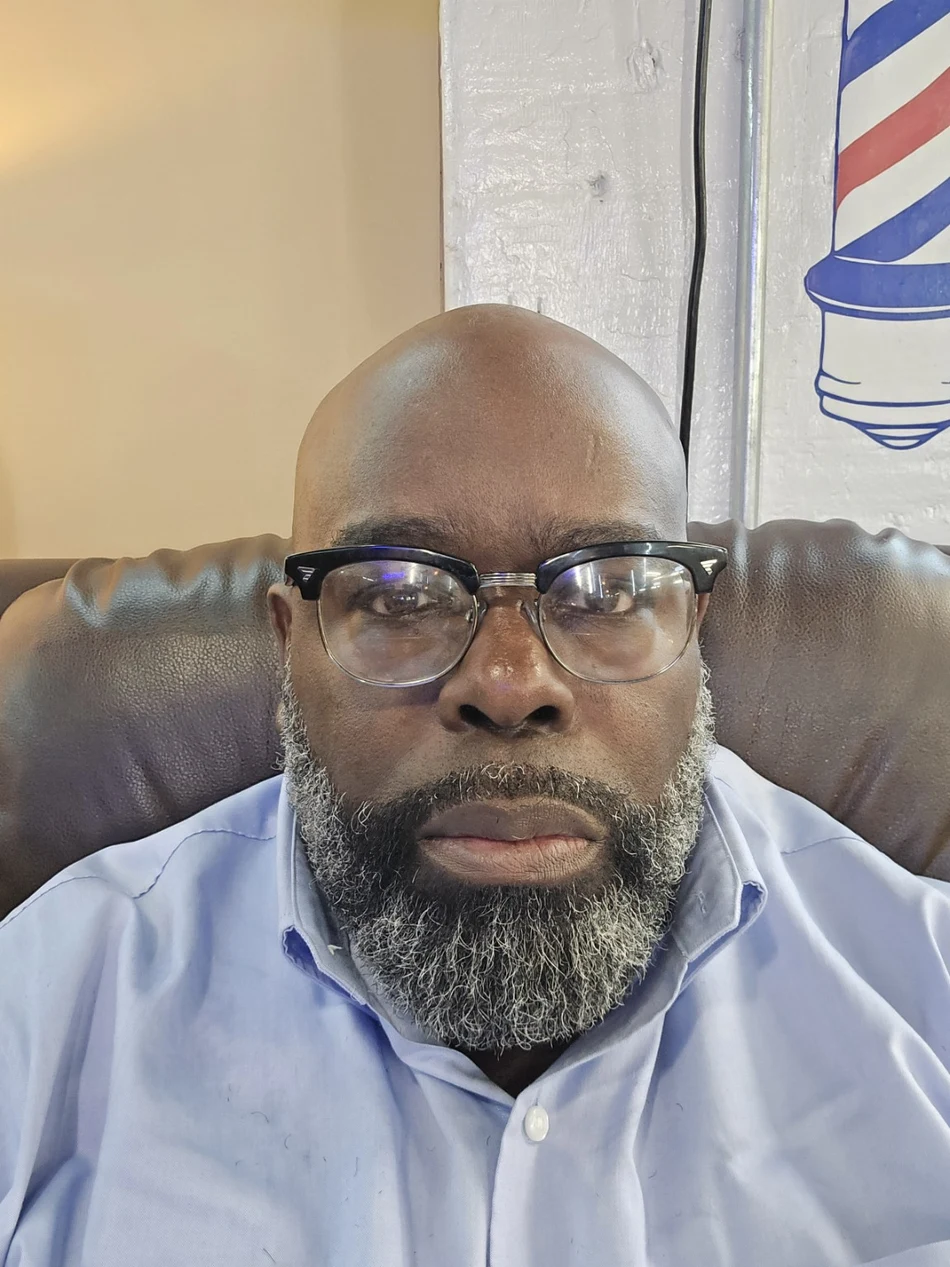
Rev. Dr. Donovan E. Price Sr. founded Solutions & Resources in 2016. His work brings together street-level crisis response, victim advocacy, spiritual care, and the practical coordination families need after violence.
Families move between hospitals, public agencies, courts, homes, and the responsibilities of daily life. SnR’s work is to help keep those connections from breaking when people are already carrying more than they should have to carry alone.
“When the police tape goes up, Solutions and Resources is there.”
Speaking, training & public dialogue ↗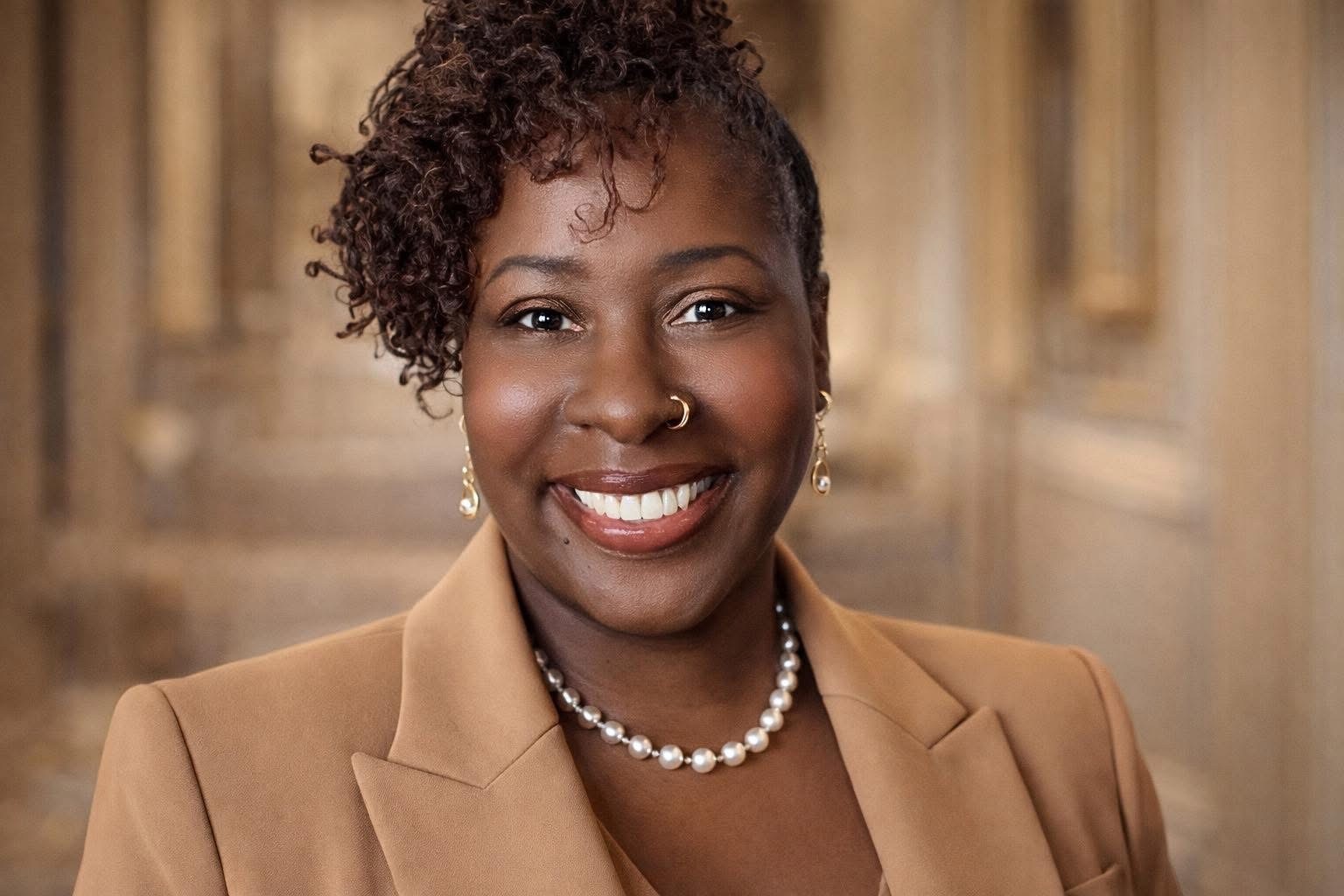
Ed.D., NCSP
Director of Trauma-Informed Care
& Family Wellness
Tiffani A. Farrow, Ed.D., NCSP, is a Nationally Certified School Psychologist licensed to practice in Illinois and Michigan and a state-endorsed Learning Behavior Specialist I (LBS1). With more than 22 years of experience serving children, adolescents, young adults, families, and educational systems, Dr. Farrow provides comprehensive psychological and educational services grounded in trauma-informed, culturally responsive, evidence-based, and equity-centered practice.
Dr. Farrow's clinical practice includes comprehensive psychoeducational assessment, consultation and collaborative problem solving, mental and behavioral health services and interventions, and the development of individualized supports addressing learning, behavior, social-emotional functioning, and psychological well-being. Through a trauma-informed lens, she considers how adverse experiences, environmental stressors, relationships, culture, and systems may influence a learner's functioning, behavior, engagement, and access to learning. Her approach emphasizes psychological safety, resilience, strengths-based practice, and responsive supports that recognize the whole child within the context of family, school, and community.
Dr. Farrow works collaboratively with students, families, educators, administrators, clinicians, multidisciplinary teams, and community providers to identify needs, interpret assessment data, develop and monitor targeted interventions, and strengthen systems of support. Her consultation and collaborative problem-solving approach is designed to connect assessment findings to meaningful interventions and to promote coordinated, practical, and sustainable supports across settings.
Her professional experience extends across diverse educational, clinical, and community-based settings. Dr. Farrow works and collaborates with early childhood programs and preschools; public, private, and charter schools; school district offices and educational agencies; colleges and universities; mental health centers, hospitals, and community agencies; and private practice settings. Across these environments, she applies a trauma-informed and collaborative approach to assessment, consultation, intervention planning, mental and behavioral health services, prevention, and continuity of care.
Consistent with the National Association of School Psychologists (NASP) Practice Model, Dr. Farrow's work places particular emphasis on consultation and collaboration, mental and behavioral health services and interventions, and family-school-community collaboration. Her practice recognizes that learning and behavior cannot be understood in isolation from emotional well-being, relationships, lived experiences, family and community context, culture, and environmental factors. She integrates these considerations into assessment, intervention, prevention, consultation, and responsive services to promote positive academic, behavioral, social-emotional, and mental health outcomes.
Dr. Farrow completed her professional training at National Louis University and Loyola University Chicago. Her areas of professional and clinical interest include trauma-informed practice, cognitive behavioral approaches, dialectical behavioral approaches, behavioral and social-emotional intervention, research- and evidence-based literacy interventions, consultation, family-school-community collaboration, and systems-level support. She has expanded her service delivery beyond traditional assessment to include consultation, counseling, advocacy, mentoring, professional development, workshops, training, and community-based educational and mental health support.
Dr. Farrow is a member of the American Psychological Association (APA), Division 16; the National Association of School Psychologists (NASP); and the Illinois School Psychologists Association (ISPA).
Director of Fiscal Compliance and Strategic HR Operations
Alicia Michelle Straughter, Ph.D. (M.A. in Organizational Development and B.A. in Communications), is a distinguished leadership strategist, HR executive, and nonprofit management consultant with over 25 years of experience in strategic HR, nonprofit and business management, and transformational leadership. She spent 20 years working alongside leadership expert and motivational speaker Stedman Graham in a senior leadership role, where she played a key part in developing youth leadership programs focused on identity-based leadership, celebrity events, nonprofit management, and personal development.
As the founder and CEO of AMS Consulting Services Inc., a minority-owned HR firm, she has successfully led initiatives in leadership development, government contract management, and organizational transformation. She has managed budgets exceeding $15 million, spearheaded impactful programs for women and youth empowerment, and coached industry leaders to develop authentic, purpose-driven leadership strategies.
Her experience extends into higher education, where she has served as an adjunct professor in the school of business, teaching and mentoring emerging leaders and designing programs that bridge academic theory with real-world leadership application.
She is also the chief creator of the Women Who Empower Chronicle, a platform dedicated to amplifying the voices of women leaders through storytelling, leadership insights, and empowerment resources.
Beyond consulting, she hosts the Soul of a Leader podcast, where she engages in transformative leadership conversations. She is also an accomplished author who co-authored Soul of a Leader Echoes from Episodes from the Soul of a Leader Podcast Guests. She is the author of Strategies and Practices of Women Who Lead and is developing a 7-day devotional for women in leadership. With a passion for mentorship, diversity advocacy, and leadership excellence, Dr. Alicia Michelle Straughter continues to push boundaries, shaping the next generation of leaders and fostering inclusive, purpose-driven workplaces.
Research helps explain the scale and uneven burden of violence. SnR’s own reporting must show what the organization did for families. Those are different questions—and both deserve honest answers.
These findings come from the University of Chicago Crime Lab. They are not 2026 live counts, SnR performance measures, or evidence of a formal research partnership.
The Crime Lab reported that Black residents were 22 times more likely to be killed than White residents.
Read the original analysis ↗The Crime Lab’s 2024 analysis reported that the share of shooting victims who died had risen 44.9% since 2010.
Read the original analysis ↗The Crime Lab reported 168 fewer homicides through mid-December 2025 compared with the same period in 2024.
Read the 2025 update ↗Progress deserves recognition. Ongoing grief deserves support.
Our position: a decline in violence does not remove the needs of families already living with its consequences.
Sources checked September 10, 2026. Refer to each report for measurement definitions, data cutoffs, and limitations. Comparisons above are not combined into a single trend line.
An impact report should distinguish the families reached, the services delivered, and the changes people report—without making their most private experiences public.
Discuss reporting & partnership →Unique families supported and incident responses, with a defined reporting period and clear counting rules.
Follow-up contacts, completed referrals, court accompaniment, and practical support—counted separately from individuals.
Consented feedback on access, navigation, and support. No claim that SnR caused a citywide crime reduction.
Reporting priorities are discussed with partners using defined periods, clear counting rules and appropriate privacy safeguards. No audited SnR performance totals are presented on this page.
HeyJackass is an independent community data source. Visit the publisher for its current figures and definitions; its counts are not presented here as official data or SnR performance measures.
Visit the independent source ↗A person, a household, a support encounter and a referral describe different things. A referral is not proof of placement; a website visit is not a family served. Citywide crime trends are not automatically SnR outcomes.
Look for a reporting period, the unit being counted, the support provided and whether the information is self-reported, administratively documented or independently evaluated. These definitions explain future reporting; they are not a new set of results or an independent evaluation.
SnR’s citywide commitment begins with recognizing that every community has people, history, strengths, and needs—not just a place in a crime table.
Support can include people and places beyond the immediate household.
Choose a name, click a shape on the map, or use the numbered directory. Your selection highlights the matching community area—not an incident or a person’s address.
Find community events ↗Community areas are not wards, ZIP codes, or every named neighborhood. This map is a geographic guide, not a dispatch service, office-location map, or record of SnR encounters.
Opening Chicago’s community map…
Published geographic boundaries—not generated shapes.Boundary source: City of Chicago Data Portal. The map requires internet to load the official boundary file. No location request, incident tracking, or personal-data collection is used.
A citywide service commitment is not a separate office in every neighborhood. Contact SnR to discuss available support.
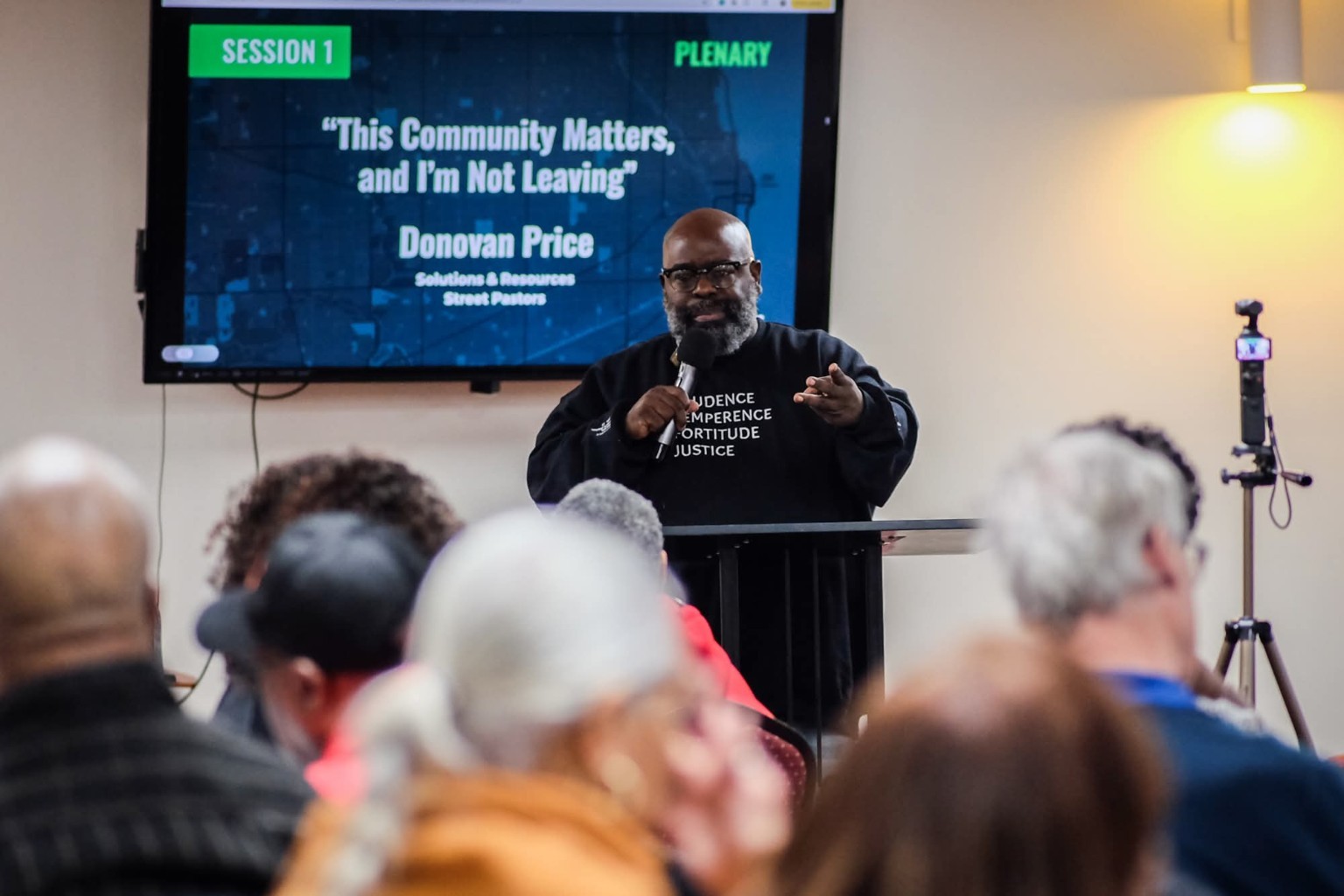
Book Pastor Donovan Price for a keynote, a facilitated conversation, or practical training on violence, grief, trust, and the responsibility to stay with families after a crisis.
Founder and Executive Director of Solutions & Resources, Pastor Donovan works where violence, grief, families, and public systems meet.
The conversation can be shaped for universities, healthcare teams, public-safety leaders, victim-service professionals, faith communities, foundations, and civic audiences.
Engagements are tailored to audience and purpose. Speaking inquiries are not confirmed bookings. Fees, travel, availability, and scope are discussed privately.
Review independent coverage & recognition ↗What violence leaves behind after the emergency response ends. A conversation about traumatic loss, human dignity, and what it means to remain present.
The first hours after violence, viewed through a family’s experience. Explore communication, coordination, and the gaps between police, hospitals, and community support.
How faith communities can meet grief without rushing it, speaking over it, or reducing practical care to comforting words.
Identify where people get lost between agencies, responsibilities, and referrals—and what meaningful, lasting support could look like.
The human cost carried by responders, advocates, clergy, and caregivers. Make room for the people whose job is to stay steady for everyone else.
Why prevention and survivor support belong in the same conversation, and why sustained care cannot depend on the length of a news cycle.
Discuss the topic, audience, duration and format with SnR before confirming an engagement. These talks are not advertised as accredited continuing education or clinical treatment.
Who will be listening? What do they need to understand? What do you hope they do differently afterward?
For speaking coordination:
dprice@solutionsandresources.org
Prepare an email inquiry, review it, then choose Open in email app and send it. Nothing is submitted by this form, and no date is reserved until SnR confirms the engagement.
Support the people, coordination and practical work that help families find their next step after violence.
Your support can strengthen scene and hospital response, family navigation, coordination and continuing care.
No donation amount is presented as buying a fixed number of services or guaranteeing an individual outcome.
Explore organizational partnerships →Build a relationship around the work families actually need: trusted response, practical stabilization, effective navigation, and sustained support.
Discuss priorities, organizational capacity, the planned Healing Center, and an appropriate reporting framework before defining a funding commitment.
Explore referral relationships, communication, survivor navigation, and practical coordination with clear responsibilities.
OVC guidance for hospitals, victim-service providers and community partners preparing a coordinated response to mass violence.
Open the OVC planning toolkit ↗For institutional planning, not an application for individual assistance.
Office for Victims of Crime · published August 2015 · source checked September 17, 2026.Bring neighborhood knowledge, volunteers, meeting space, practical resources, or training needs into a shared conversation.
SnR’s Healing Center vision brings advocacy, family support, wellness, group spaces, technology access, and community connection into one thoughtful environment.
Explore the planned center →Detailed budgets, organizational planning, and institutional due-diligence materials do not belong on an unrestricted page.
Request institutional information ↗
Explore the planned SnR Healing Center.
Step inside the vision Concept rendering · not an operating facilityCall SnR at 872.702.1313 to discuss a possible referral and an appropriate next step. Begin with your role and the general type of support needed. Confirm the person’s permission and the appropriate way to communicate before sharing private information.
Do not send medical records, case files, Social Security numbers or private addresses through general email or this website. A referral discussion does not guarantee acceptance, funding, a clinical appointment or immediate response.
See the public Get Help pathway →A planned SnR Healing Center that would strengthen existing youth and family support, with space for grief care, family connection, practical advocacy and continuing healing.
Planned · Not an operating facility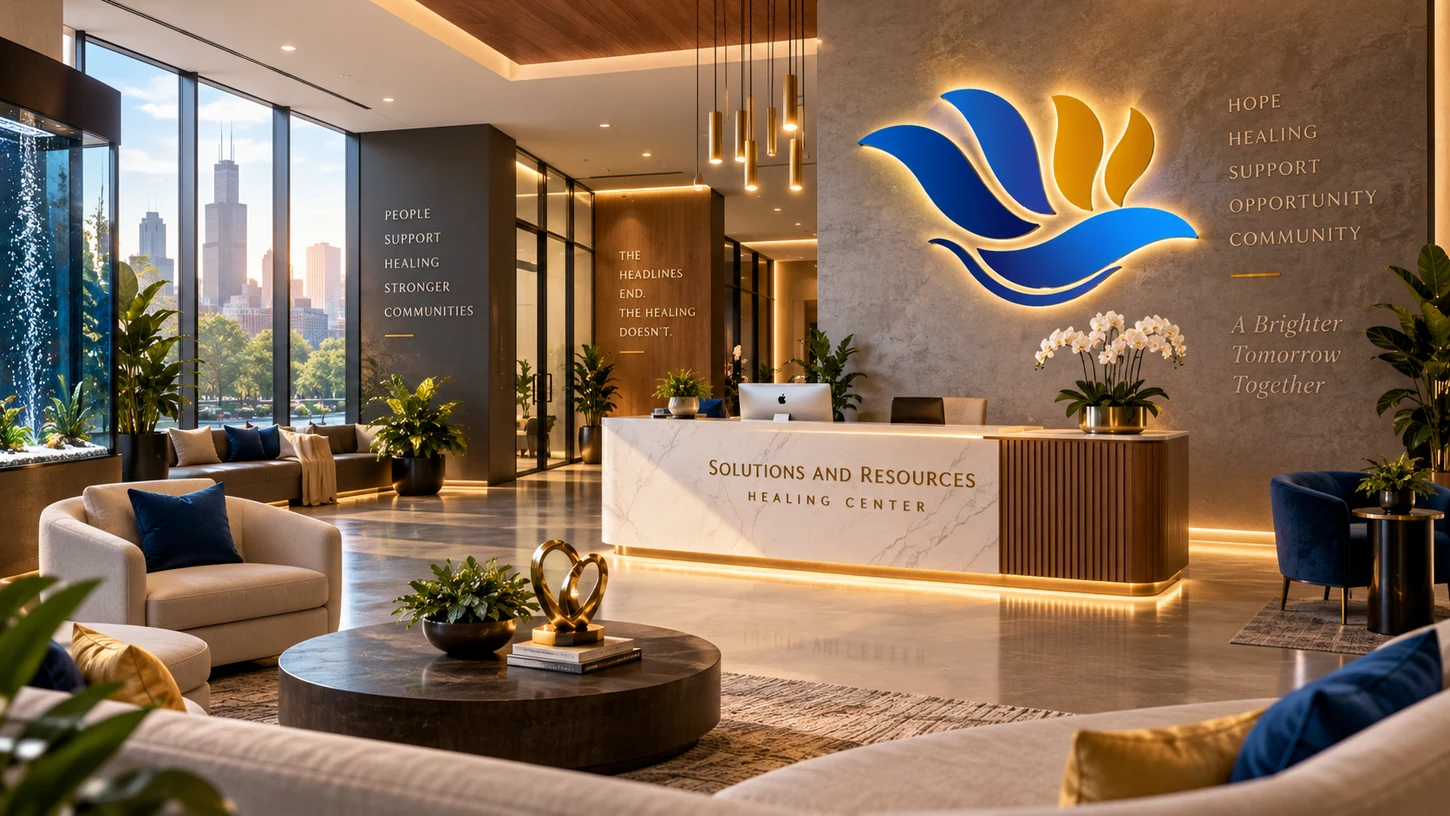
A proposed home for family support, private conversations, individual and group wellness, and coordinated navigation.
Spaces for learning, gathering, technology access, and the practical work of reconnecting people with resources.
A vision for creative expression, storytelling, and community dialogue—always grounded in consent and dignity.
A considered selection—not a wall of logos. News coverage helps people understand the work; it is not an institutional endorsement.
CBS News Chicago
Solutions and Resources (SnR) helped a Spanish-speaking family connect with resources following the death of their seven-year-old daughter and led a balloon release and vigil in her memory.
CBS Chicago’s coverage includes Pastor Donovan Price speaking at the vigil.
Solutions and Resources (SnR) ayudó a una familia de habla hispana a encontrar recursos tras la muerte de su hija de siete años y encabezó una suelta de globos y una vigilia en su memoria.
La cobertura de CBS Chicago incluye al pastor Donovan Price hablando durante la vigilia.
Aviso sobre el contenido: El reportaje trata de la muerte violenta de una niña y muestra a familiares en duelo. El video y el artículo de CBS están en inglés.
Ver el reportaje en CBS Chicago (en inglés; nueva pestaña)Content note: This report discusses a child’s violent death and shows grieving family members.
Watch CBS report2:33 · EnglishOpens the official CBS News Chicago video in a new tab.
Kate Snow followed Pastor Donovan Price as he supported families in Chicago during NBC News’ July 2022 reporting on the human aftermath of gun violence. Content note: the linked account discusses shootings, death and bereavement.
Read Kate Snow’s account ↗FBI Chicago’s announcement recognizes Rev. Dr. Donovan E. Price Sr. and describes SnR’s victim advocacy, crisis intervention, and assistance to families affected by violence.
Read the primary source ↗Recognition is described accurately; no government seal or implied agency endorsement is used.
For interviews, panels, and documentary inquiries
Contact dprice@solutionsandresources.org or 872.702.1313. Any access involving survivors or families requires their informed consent and appropriate privacy safeguards.
Books, short videos, practical tools, and connections for survivors, families, neighbors, and people who care.
Immediate help · Chicago / Cook
Orders of protection, shelter referrals and an advocate. Start here without answering questions.
Effective January 1, 2027. Not yet in effect as of this notice’s publication on September 16, 2026.
Public Act 104-0563 amends the Crime Victims Compensation Act. This advance notice may help survivors, families and advocates prepare.
Need help now? Do not wait for 2027. Use the Attorney General’s current program and application instructions. Ask which rules apply to your situation, especially for a claim spanning the effective date. This is general information, not individualized legal advice or a guarantee of payment.
Sources: Illinois General Assembly, Public Act 104-0563, Sections 4.2, 6.1, 7.1 and 10.2; Illinois Attorney General program page. Published and source-checked . Recheck official guidance before relying on this dated summary.
Effective January 1, 2027. Not yet in effect as of this notice’s publication on September 22, 2026.
Public Act 104-0832 amends Illinois law governing Children’s Advocacy Centers and the Bill of Rights for Children. This advance notice is for children, non-offending parents and caregivers, families, schools and helpers supporting a child through an investigation.
This is an advance legal-information notice, not an SnR service offer. Individual procedures depend on the investigation, jurisdiction and available resources. SnR does not determine whether a case is accepted for investigation, conduct CAC forensic interviews, or guarantee access to a particular center or service.
Source: Illinois General Assembly, Public Act 104-0832, including the Children’s Advocacy Center Act and Bill of Rights for Children amendments. Published and source-checked . Recheck official instructions and case-specific procedures before relying on this dated summary.
Effective now. Public Act 104-0802 took effect August 7, 2026.
The law amended Section 304 of the Illinois Domestic Violence Act. It removed the statutory requirement that officers use the Adolescent Domestic Battery Typology Tool when deciding whether to arrest, divert, or assist with alternative placement in a case involving a juvenile alleged offender. It also removed the former automatic requirement in this section to forward every non-arrest incident report to the State’s Attorney for review.
This is general legal information, not an SnR decision or legal representation. SnR does not determine whether an arrest is made, whether a juvenile is diverted, whether charges are filed, or whether a prosecutor takes a case. Use official local procedures for case-specific questions.
Source: Illinois General Assembly, Public Act 104-0802, amending 750 ILCS 60/304. Effective August 7, 2026; source-checked . Recheck official local procedures before relying on this dated summary.
Effective now; Medicaid status checked October 1, 2026. Special Marketplace enrollment verified October 26, 2026. A September 21 federal court ruling, the October 1 Medicaid eligibility change and the temporary Get Covered Illinois enrollment pathway are separate developments.
Do not assume the court ruling restores Medicaid, that survivor status alone determines eligibility, or that every person who lost Medicaid qualifies for Marketplace coverage or financial help. These are separate legal and program changes. Check the specific program, current HFS notice and Get Covered Illinois determination before relying on this summary. This is general information, not immigration, legal or insurance advice and not an SnR eligibility determination.
Sources: Illinois Attorney General, September 21, 2026; Illinois Department of Healthcare and Family Services, current noncitizen Medicaid guidance; Get Covered Illinois special-enrollment announcement, October 14, 2026. Published and source-checked . The 90-day document-verification clarification and its HFS FAQ were checked . Medicaid effective-status wording was checked . The December 31 special-enrollment pathway was verified . Recheck official guidance before relying on this dated summary.
Effective now. Public Act 104-0775 took effect August 7, 2026.
This does not make an order automatic. Courts still apply the underlying statutory requirements and case-specific facts. SnR does not determine eligibility, whether statutory requirements are met, or whether a court will grant relief.
Source: Illinois General Assembly, Public Act 104-0775. Effective August 7, 2026; source-checked . Recheck official court procedures before relying on this dated summary.
If you were told your loved one is at the Cook County Medical Examiner’s Office, call Intake before traveling. After an overnight death, make this a first call the following day at opening; check the different public-office and identification hours in the guide. Follow any earlier instructions from staff. Not every case requires an in-person visit.
Browse a selected directory of outside services, learning resources and official notices. Manual filters stay in this page. Smart Find can categorize a short, general phrase; do not enter names, addresses, case numbers, medical details or sensitive records. No GPS is used.
Enter only the general kind of help you are looking for, such as “housing after violence,” “grief support for a child,” or “someone is monitoring my phone.” Smart Find can choose one approved directory topic. It cannot give case advice, decide eligibility, create a referral, or dispatch help.
Privacy: Ordinary filters stay in your browser. If you use Smart Find, the general words you type are sent to this site’s AI service for one-time categorization. SnR does not intentionally save that phrase through this tool. Do not include identifying or case-specific information.
You can skip Smart Find and use the filters below.
Location is not eligibility. A community choice can move a listed location earlier; it never removes a matching resource. We do not calculate distance or show live beds or appointments. Do not enter private case information in the directory search.
23 selected public resources and notices. Filters need JavaScript; every listing is readable below without it.
No matching listing in this small directory. Try another topic or reset the filters. A missing result does not mean you are ineligible for support.
For victims and witnesses whose safety is at risk during a violent-crime prosecution. Cook County Victim Specialists may help arrange relocation after a case is charged.
Not sure who that is? Contact
Cook County Victim Services
Not general housing assistance. Eligibility and help are case-specific. SnR does not award these funds or guarantee placement.
Immediate danger or medical emergency? Call 911. This referral is not emergency dispatch.
This is a selected directory, not a complete inventory of services in all 77 community areas. Source-check dates differ by listing. Providers determine eligibility and availability. SnR does not operate every listed service. Immediate danger or medical emergency: call 911.
Faith-based grief and trauma resources are here when that is the kind of support you are seeking. Faith-based materials are optional; the rest of the library remains available.
Choose what feels useful. Preview children’s materials with a trusted adult. These outside resources are educational, not personal treatment advice; inclusion does not imply a partnership or endorsement by the publisher. Book links go to publishers, not an affiliate checkout. Ask your library about borrowing.
17 resources · publisher details and original check dates apply
Choose the material intended for your role. These are educational resources, not assessments, diagnoses or enrollment in SnR services. External links open in a new tab.
NCTSN: Helping Your Family Cope ↗
Practical ways family members can support one another after an emergency.
NCTSN: Connecting with Others — For Students ↗
Student-facing information about finding and giving social support. A trusted adult can help you read it.
NCTSN: Psychological First Aid for Schools — professional guide ↗
For school administrators, educators and staff. Not a parent self-assessment manual or a substitute for individual care.
Links, language and intended audience checked: .
A perspective on living alongside grief rather than being pressured to “get over it.” Includes reflections for people supporting someone after a loss.
Adult reading; discusses death and the author’s loss. A book is not a substitute for individual care.
Publisher & book details ↗An exploration of grief, mourning, and the ways people can support themselves and one another after a death.
Includes spiritual questions. Choose the sections that fit; no prescribed timetable is implied by this listing.
Publisher/distributor details ↗An illustrated way for children and adults to talk about beginnings, endings, and the lives of people, animals, and plants.
Read with a trusted adult. It introduces death generally; it is not a guide to explaining a particular violent incident.
Publisher & book details ↗A short animation about acknowledging grief rather than trying to cheer it away. Useful before reaching out to a friend, neighbor, or coworker.
Discussion of loss. Opens the creator’s page; no automatic playback or copied footage.
Watch on the creator’s site ↗Elmo and Jesse talk about feelings after a death, with an activity for remembering the person who died.
For young children with a caregiver. Preview first; English and Spanish options are available on the source page.
Watch with a caregiver ↗A conversation about remembering loved ones and the ways families can celebrate their lives.
Mentions deaths including COVID-19. Preview with the child’s age and circumstances in mind.
Watch on Sesame Workshop ↗A brief starting point for adults supporting toddlers, preschoolers, and other young children following a traumatic event.
Multiple language versions are linked by the publisher. General guidance, not an assessment of an individual child.
Read the guide ↗Youth- and family-focused materials about community violence, responses, safety, and support.
Some materials discuss violence. Choose the audience and content before sharing with a child or a group.
Explore the collection ↗Practical ideas for offering support and recognizing when a person may need more than informal help.
For friends, neighbors, coworkers, and other supporters. Do not require people to share an incident narrative.
Read the handout ↗An evidence-informed response framework with practical assistance, connection, and support information for the aftermath of disaster and terrorism.
For trained or appropriately supported helpers. Reading a guide does not create clinical qualifications or authorize deployment.
Read the professional guide ↗Guidance for school leaders and staff responding to disasters, violence, or terrorism, with materials for students and caregivers.
For coordinated school response, not a substitute for a school’s safety procedures or individualized care.
View the school guide ↗Start with the state’s official information about assistance, applications, and eligible expenses following violent crime.
Eligibility and reimbursement are determined by the program. A website listing does not guarantee payment.
Visit the official program ↗Information about community-based peer support for young people facing loss and change.
Ask the organization about nearby sites, eligibility, availability, and costs before making plans.
Explore youth support ↗Explains the role of peer connection and why a support group is different from treatment for PTSD.
General education. Use a qualified professional for assessment or treatment needs.
Read about peer support ↗A Bible-based guide to spiritual first aid after natural or human-caused disasters, with practical ideas for caring for yourself and others.
Faith-based perspective. The publisher describes it as especially helpful after the initial shock has passed. Use at your own pace; not emergency care or individualized treatment.
Read about the guide & free downloads ↗A Christ-centered grief-support program combining video teaching, group conversation, and a participant guide. Explore the introduction and find in-person or online groups.
For people grieving someone’s death. Full seminar videos are part of the program, not an unrestricted free video library. Confirm cost, access, and suitability with the host.
Explore the videos & find a group ↗A Bible-based family resource for uncertain times, especially after a disaster. Designed for families with children ages 8–12.
Preview with a trusted adult. Offered in English, Spanish, Russian, and Ukrainian. This is a faith-based conversation resource, not a diagnosis or a substitute for a child’s individual care.
Find God Is With Me on the publisher’s page ↗Choose a short reflection—or reach a person. Neither requires you to explain your loss here.
Explore organizer-listed support groups and gatherings in Chicago or online. Check the audience, format, and access details before you make plans.
Listings checked October 26, 2026. These are outside organizations’ events—not SnR-hosted sessions. A listed date does not guarantee a place. Confirm registration, time zone, accessibility, costs, and any intake requirement with the organizer. A remembrance walk is not a therapy group.
Monday, October 26, 2026 · 7:30–9:00 p.m.
Online via Zoom
For adults who have experienced the death of a loved one within the past two years. JCFS describes this as a free monthly group; registration is required.
JCFS Chicago and community co-sponsors. This is an outside-organizer event, not an SnR-hosted session.
Official organizer listing ↗ Source checked October 26, 2026.Tuesday, November 3, 2026 · 10:30 a.m.–12:00 p.m.
Online
A virtual drop-in grief support group for older adults who have experienced the death of a spouse or partner within the past two years. Contact the organizer for the Zoom link.
JCFS Chicago. This is an outside-organizer group; confirm participation details directly with JCFS.
Official organizer listing ↗ Source checked October 26, 2026.Tuesday, November 10, 2026 · 7:00–8:00 p.m.
Online via Zoom
A monthly drop-in support group for adults grieving the loss of a loved one to suicide. JCFS says the group welcomes people from the Jewish community and beyond.
JCFS Chicago and co-sponsors. This is an outside-organizer event, not an SnR-hosted session.
Official organizer listing ↗ Source checked October 26, 2026.Saturday, November 14, 2026 · 9:30 a.m.–12:30 p.m.
Victory in Christ Kingdom Church · 2735 W. 79th Street, Chicago, IL 60652
GriefShare lists this as a one-time, in-person, English-language Surviving the Holidays event. The organizer lists the event as free. Confirm registration and participation details on the event page before attending.
Outside faith-based organizer. Listing here does not require religious participation in SnR services and is not an SnR-hosted program.
Official GriefShare event & registration ↗ Source checked October 26, 2026.Some organizations publish opportunities through their own calendar or a direct inquiry. These links help you find the next suitable gathering.
Violent-loss survivor groups, workshops, memorial activities, and gatherings. Contact the organizer for the next date and eligibility.
Check the organizer’s page ↗An organizer of programs and events for women affected by trauma and abuse. Check which offerings are support groups, workshops, or fundraisers.
Check the organizer’s page ↗Grief groups and workshops with age, loss-type, location, and registration details on each listing. Check the current calendar for additional dates.
Check the organizer’s page ↗Find church-hosted or online support for grief after a death. Check the organizer’s current dates, cost, and access; no Chicago meeting is assumed from the directory alone.
Check the organizer’s page ↗Send the public organizer link, date, audience, location, and any cost or registration requirement to SnR for review. Please do not include participant names or private stories. Listings need to be checked before they are added.
Suggest an event →Support should see the person who was hurt—and the people around them whose days, relationships, and places may now feel different.
Choose a perspective below. These are starting points for a conversation, not a demand to disclose or a guarantee of a particular service.
Being part of the response does not entitle anyone to a family’s story, a child’s photograph, or a patient’s medical information.
Ask before sharing details. Offer a specific task rather than pressure to talk. Share verified support information. Make space for employees, neighbors, and young people to decline a conversation or a public gathering.
Businesses can help sustain the network—with permission-based support for staff, trusted information, community partnerships, and contributions to the work—without turning someone’s loss into a promotion.
Practice context: NCTSN on the effects of community violence and giving social support. People respond differently; this page does not diagnose anyone.
You can read these perspectives directly, as well as use the choices above.
Physical recovery, information, privacy, practical needs, and emotional support may all matter. Let the person’s priorities lead. An advocate should not assume what they need, how they feel, or that they want their story told.
Relatives, partners, close friends, and chosen family may be making decisions while managing grief and the needs of others. Relationships differ, and care should leave room for the people the survivor identifies as important.
Someone may have seen the incident, heard it from home, sheltered with children, or returned to find their block changed. They do not have to be related to the victim to ask about support. A community response should listen without turning the block into a public case file.
Solutions and Resources (SnR) supports young people and families affected by violence and traumatic loss. A young person may be grieving a parent, sibling or friend, recovering from an injury, or carrying the impact of violence they witnessed.
When clinical care is needed, SnR can help identify appropriate qualified providers. Contact SnR to discuss available support for your situation.
Talk with SnR about a young person · 872.702.1313 ↗
Meet Beyond the Moment → Planned launch: November 2026
A child may be affected through a friend, a sibling, something witnessed, or the fears of adults around them. Adults can seek age-appropriate guidance without making the child repeatedly explain what happened. School and caregiver coordination should protect the child’s privacy.
Solutions and Resources (SnR) recognizes that violence and loss can affect children and adolescents even without a physical injury. Young people may show distress differently. Changes from a child’s usual behavior can be a reason to seek support; they do not, by themselves, establish a diagnosis.
Caregivers can listen, protect privacy and seek appropriate support. Schools can involve qualified student-support personnel and school-based resources. Additional community or clinical support may also be needed. SnR can discuss possible next steps. Young people and caregivers do not need to retell what happened through this website to ask about support.
School & caregiver resources: choose your audience →
NCTSN: understanding children’s responses to loss ↗ · Source checked:
A shop owner, restaurant team, driver, customer, or worker nearby may carry both the memory of the incident and practical concerns. Emotional support and business recovery are related but distinct. A staff conversation should not require public disclosure or a group retelling.
A consistent response depends on people who can coordinate without taking over. Clergy, volunteers, organizers, and professional responders need clear roles, appropriate boundaries, and support for themselves. No one should have to be the entire care system alone.
Solutions and Resources (SnR) recognizes that supporting others through violence, trauma and loss can affect teachers, counselors, school staff, responders, clergy and community helpers, too. Needing support does not by itself mean someone has a clinical condition.
Support should not rest on the individual alone. Supportive supervision, healthy workplace practices, peer support and access to appropriate resources matter alongside personal wellbeing. Ask about support for yourself without sending a child’s or survivor’s private information through a general website form.
NCTSN: support for people working with trauma ↗ · Source checked:
For grief. For the first difficult hours. For the people who care, the whole block, and the days that follow. Choose what fits; leave the rest.
These are words of support, not instructions on how to feel. Faith-based reflections are an optional theme you can choose. Nothing rotates automatically, and this website does not submit or save reflection searches or selections.
You can reach SnR without knowing exactly what to say.
This page explains the website’s current features. You can call SnR without entering information into a form.
Quick Exit: the fixed Quick Exit button leaves this website for a neutral weather page. It does not erase browser history, downloads, messages, device logs, or other evidence of browsing. If you believe a device is monitored, consider using a safer device when possible.
Community choices, resource searches, reflection themes and speaking drafts are processed in your browser. This site does not submit those selections or drafts to SnR. A motion preference may be saved on this device until you change it or clear site storage.
The hosting provider may process routine technical information, such as IP addresses and request logs, to deliver and operate the site. That is different from sending SnR a request for assistance. Read the hosting provider’s privacy information.
The speaking form prepares an email draft on your device. It is not sent until you open your email application and send it yourself. Email is not an emergency channel and does not reserve an engagement. Please do not include medical records, case documents, Social Security numbers, private addresses or other sensitive survivor information.
For general inquiries: dprice@solutionsandresources.org. For support: 872.702.1313. Call 911 for immediate danger or a medical emergency.
Donations are completed on SnR’s external Aplos giving page, not inside this website. Confirm the organization, amount and recurring-gift settings there. Publisher links, organizer calendars and map data are outside services with their own availability and privacy practices. No detailed fiscal documents are publicly provided here.
Use Pause motion to stop decorative movement. Your device’s reduced-motion preference is respected. Community-area choices are available through a named dropdown as well as the map. Reflections open only when you choose them.
If something prevents you from using the site, send accessibility feedback or call 872.702.1313. Describe the page and what did not work; you do not need to share your personal story.
Website information updated September 10, 2026. Resources support learning and connection; they are not a diagnosis, treatment plan, legal representation or a guarantee of service availability.
A little encouragement. A practical next step.
Good things to pin. No thumbtacks required.
Shared by Solutions and Resources for survivors, families, witnesses and helpers. Outside providers determine eligibility and availability. No application or case information is collected here.
Who this may help Victims and witnesses whose safety is at risk while participating in a violent-crime prosecution.
Cook County State’s Attorney Victim Specialists may help arrange relocation to safer housing. The office describes specialist support after a case is charged.
Important: This is not general housing assistance. Eligibility and available help require individual review. SnR does not award these funds or guarantee placement.
Source: Cook County State’s Attorney · Checked
Who this may help Anyone receiving an unexpected compensation “award” call, email or text.
The U.S. Office for Victims of Crime warns that scammers use OVC or FBI names to seek money or personal information, sometimes claiming an award.
Do not reply with money, banking details or sensitive information. Look up the agency’s real contact on its official website—not in the unexpected message.
Keep legitimate applications on track. Real applications may require documentation. Verify the contact rather than abandoning your application.
Source: U.S. Office for Victims of Crime
Warning: · Checked
New filing location Beginning September 21, 2026
Who this affects People filing or following a Chicago Stalking No Contact Order matter.
Richard J. Daley Center
50 W. Washington Street
Concourse Level · Room CL24
These filings move from 555 W. Harrison Street. Pending Chicago matters under the same Act also transfer. Confirm your courtroom, date and filing instructions before traveling.
Stalking No Contact Orders only. This does not move Domestic Violence Act proceedings, Civil No Contact Order Act proceedings, or criminal stalking cases. SnR shares public information, not individualized legal advice.
Source: Circuit Court of Cook County
Announcement: · Checked
Effective January 1, 2027. Not yet in effect as of this notice’s publication on September 16, 2026.
Public Act 104-0563 amends the Crime Victims Compensation Act. This advance notice may help survivors, families and advocates prepare.
Need help now? Do not wait for 2027. Use the Attorney General’s current program and application instructions. Ask which rules apply to your situation, especially for a claim spanning the effective date. This is general information, not individualized legal advice or a guarantee of payment.
Sources: Illinois General Assembly, Public Act 104-0563, Sections 4.2, 6.1, 7.1 and 10.2; Illinois Attorney General program page. Published and source-checked . Recheck official guidance before relying on this dated summary.
Effective January 1, 2027. Not yet in effect as of this notice’s publication on September 22, 2026.
Public Act 104-0832 amends Illinois law governing Children’s Advocacy Centers and the Bill of Rights for Children. This advance notice is for children, non-offending parents and caregivers, families, schools and helpers supporting a child through an investigation.
This is an advance legal-information notice, not an SnR service offer. Individual procedures depend on the investigation, jurisdiction and available resources. SnR does not determine whether a case is accepted for investigation, conduct CAC forensic interviews, or guarantee access to a particular center or service.
Source: Illinois General Assembly, Public Act 104-0832, including the Children’s Advocacy Center Act and Bill of Rights for Children amendments. Published and source-checked . Recheck official instructions and case-specific procedures before relying on this dated summary.
Effective now. Public Act 104-0802 took effect August 7, 2026.
The law amended Section 304 of the Illinois Domestic Violence Act. It removed the statutory requirement that officers use the Adolescent Domestic Battery Typology Tool when deciding whether to arrest, divert, or assist with alternative placement in a case involving a juvenile alleged offender. It also removed the former automatic requirement in this section to forward every non-arrest incident report to the State’s Attorney for review.
This is general legal information, not an SnR decision or legal representation. SnR does not determine whether an arrest is made, whether a juvenile is diverted, whether charges are filed, or whether a prosecutor takes a case. Use official local procedures for case-specific questions.
Source: Illinois General Assembly, Public Act 104-0802, amending 750 ILCS 60/304. Effective August 7, 2026; source-checked . Recheck official local procedures before relying on this dated summary.
Effective now; Medicaid status checked October 1, 2026. Special Marketplace enrollment verified October 26, 2026. A September 21 federal court ruling, the October 1 Medicaid eligibility change and the temporary Get Covered Illinois enrollment pathway are separate developments.
Do not assume the court ruling restores Medicaid, that survivor status alone determines eligibility, or that every person who lost Medicaid qualifies for Marketplace coverage or financial help. These are separate legal and program changes. Check the specific program, current HFS notice and Get Covered Illinois determination before relying on this summary. This is general information, not immigration, legal or insurance advice and not an SnR eligibility determination.
Sources: Illinois Attorney General, September 21, 2026; Illinois Department of Healthcare and Family Services, current noncitizen Medicaid guidance; Get Covered Illinois special-enrollment announcement, October 14, 2026. Published and source-checked . The 90-day document-verification clarification and its HFS FAQ were checked . Medicaid effective-status wording was checked . The December 31 special-enrollment pathway was verified . Recheck official guidance before relying on this dated summary.
Effective now. Public Act 104-0775 took effect August 7, 2026.
This does not make an order automatic. Courts still apply the underlying statutory requirements and case-specific facts. SnR does not determine eligibility, whether statutory requirements are met, or whether a court will grant relief.
Source: Illinois General Assembly, Public Act 104-0775. Effective August 7, 2026; source-checked . Recheck official court procedures before relying on this dated summary.
Status verified October 18, 2026. Illinois HFS says the partial-payment processing issue was resolved as of October 16, 2026. Solutions and Resources (SnR) is sharing the official portal and payment update.
HFS confirms that its new eServices portal is available to registered Child Support Services parents. To register or access your account, begin at the official HFS page below and choose Online Services. Registration and access remain subject to HFS requirements; contact HFS if you need help.
A released amount may not be immediately available, and portal availability does not guarantee successful access or a payment arrival date. HFS’s October 16 update does not establish that every affected recipient has already received the remaining amount. SnR does not control the HFS system, individual case access, payment processing, or when your bank or payment method makes funds available. For individual case, payment or registration questions, call Illinois Child Support Services at 800-447-4278.
Sources: Illinois Department of Healthcare and Family Services Child Support Services main page and system-upgrade FAQ. Published and source-checked . Payment schedule previously checked . Portal availability and earlier payment guidance verified . HFS says the partial-payment issue was resolved as of ; that update was verified . Follow current HFS instructions for your case.
Effective now. Illinois IDHS says TANF payment levels increased to 35% of the Federal Poverty Level for the applicable family size beginning with the October 2026 payment month.
The same TANF payment levels are used when processing cash benefits under the Victims of Trafficking, Torture, and Other Serious Crimes (VTTC) program and the Refugee Resettlement Program (RRP). Child-only TANF remains at 75% of the comparable adult-and-child TANF payment level.
Do not assume every household receives the maximum amount or qualifies under a new standard. SnR is sharing official public information and does not determine TANF, VTTC, RRP, Family Assist, SNAP or State Food eligibility, payment amounts, sanctions, recoupments or benefit decisions.
Source: Illinois Department of Human Services, MR #26.25, dated September 23, 2026. Effective October 1, 2026; source-checked .
Not in effect yet. HFS says current coverage is not changing now because of these work requirements. Current ACA Adult customers are first affected at their 2027 redetermination; the first group has March 2027 redeterminations.
HFS mailed notices in September 2026 to ACA Adult customers it believes may be affected. New ACA Adult applications submitted after 5:00 p.m. on December 31, 2026 are subject to the new rules.
SnR does not determine ACA Adult status, exemptions, qualifying activity, eligibility, or whether coverage ends. Follow the notice HFS sends about your own case and use HFS official instructions.
Sources: Illinois HFS HR 1 Customer Notices and Upcoming Changes to Medicaid. Source-checked . Recheck HFS because implementation guidance may change before 2027.
Effective now. Public Act 104-0099 permits IDHS, a regulating local government, or law enforcement with jurisdiction to monitor compliance beginning October 1, 2026.
The expanded law covers specified employers including lodging establishments, restaurants, and truck stops. Covered employees with recurring public contact must receive qualifying human-trafficking recognition and reporting training under the Act.
Covered employers should confirm the current qualifying curriculum with IDHS or the regulator that oversees them. SnR is sharing public information only; SnR is not certifying compliance and is not representing that it provides the mandated training.
Sources: Illinois General Assembly Public Act 104-0099 and current IDHS human-trafficking curriculum page. Source-checked .
October 1 priority window. DCEO says LIHEAP applications are open now for households with an adult age 60+, a person with a disability, a child age 5 or younger, or an urgent utility/energy crisis such as disconnection, a disconnect date within 7 days, or very low propane.
A request is not a guaranteed award or discount. Eligibility, benefit amount, utility-specific discount, documentation and funding availability are determined by DCEO, the local administering agency, or the utility—not SnR.
Source: Illinois Department of Commerce & Economic Opportunity, Utility Bill Assistance — How to Apply. Source-checked . Confirm current eligibility and funding before relying on this dated summary.
Beginning October 30, 2026. Illinois HFS says the Head of Household who receives case notices will be the only household member who can create the ordinary customer ABE Manage My Case account.
This change affects account access, not whether a household qualifies for medical, food, or cash benefits. SnR does not create, recover, close, link, or decide access to ABE accounts. Do not send SnR passwords, security answers, case records, Social Security numbers, or identity-proofing information.
Source: Illinois Department of Healthcare and Family Services, ABE Manage My Case FAQs. Source-checked . The FAQ gives October 30, 2026 for the one-account-per-household change. HFS describes a separate Experian identity-proofing change on the same page but does not state an October 30 effective date for that separate change.
PRB lists an En Banc hearing for Thursday, October 29, 2026, at 9:00 a.m. in Springfield. The official page says registration is open for each scheduled case and allows people to register to speak on behalf of or in protest of an individual on the agenda. During the public hearing, PRB says the individual in custody and a victim or victim representative may present testimony, with limited additional speakers permitted.
October 29 is the hearing date, not a universal victim-statement or registration deadline. Confirm case-specific participation, capacity and language-access arrangements directly with PRB.
The Illinois Prisoner Review Board states that, effective with the September 2026 docket and going forward, Medical Release (Joe Coleman Act) hearings begin at 9:00 a.m. PRB now lists Medical Release hearings for Friday, October 30, 2026 and has split the large docket into two panels. Both official panel agendas state that public hearings begin at 9:00 a.m.
For these Medical Release matters, the Board states that crime victims receive 30 days’ notice and may respond and/or speak at a public hearing if they choose. October 30 is the hearing date, not a registration deadline. Individual notification status and participation requirements should be confirmed with PRB.
This is public information from the Illinois Prisoner Review Board shared by Solutions and Resources. It is not individualized legal advice, does not determine eligibility, and does not mean SnR controls PRB scheduling or notification.
Encouragement and practical support, at your pace.
Try another word, or clear the filters to see everything.
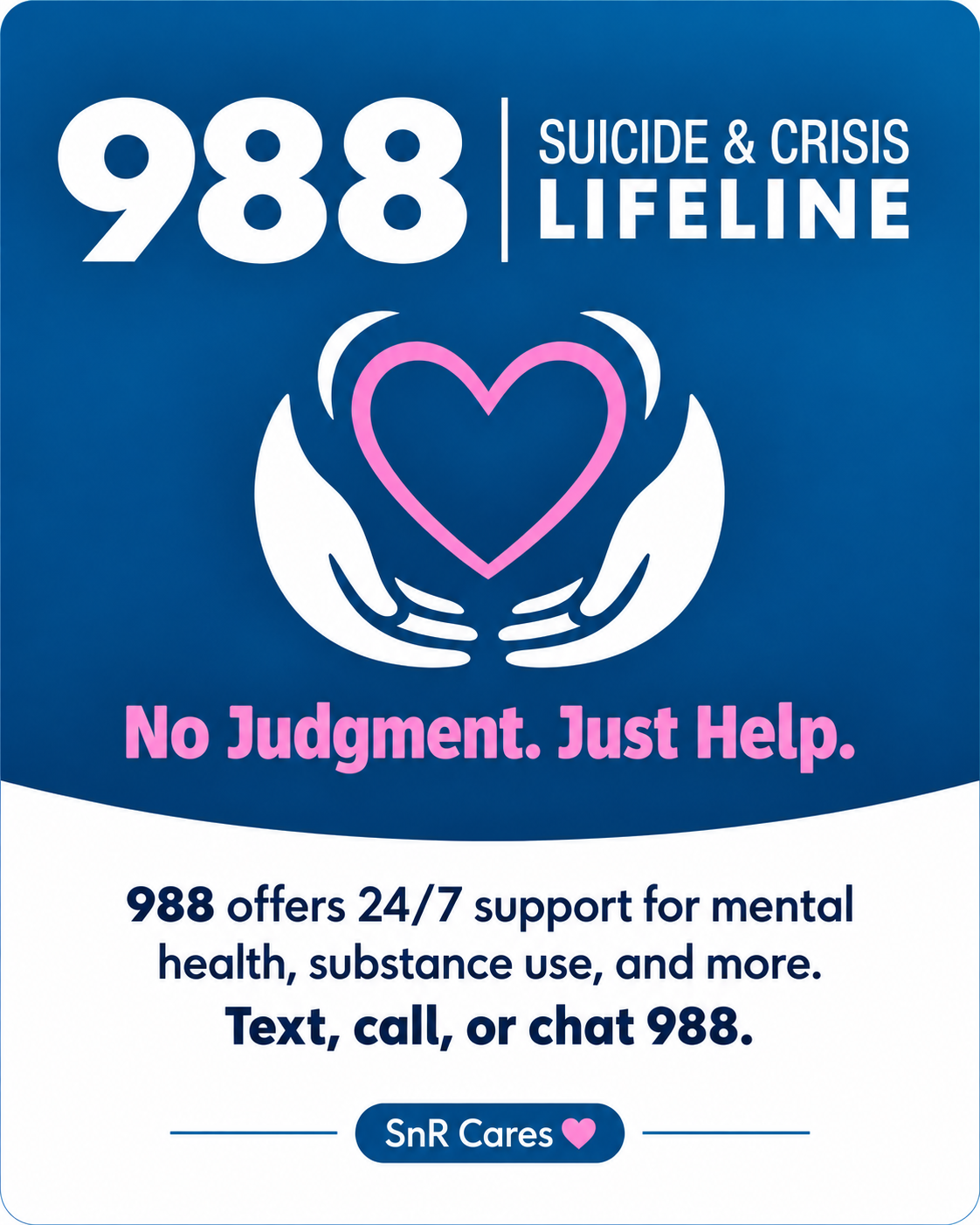
No Judgment. Just Help. Keep crisis-support information close.
988 is a separate national service, not an SnR-operated phone line. Use the written contact options below. For immediate danger or a medical emergency, call 911.
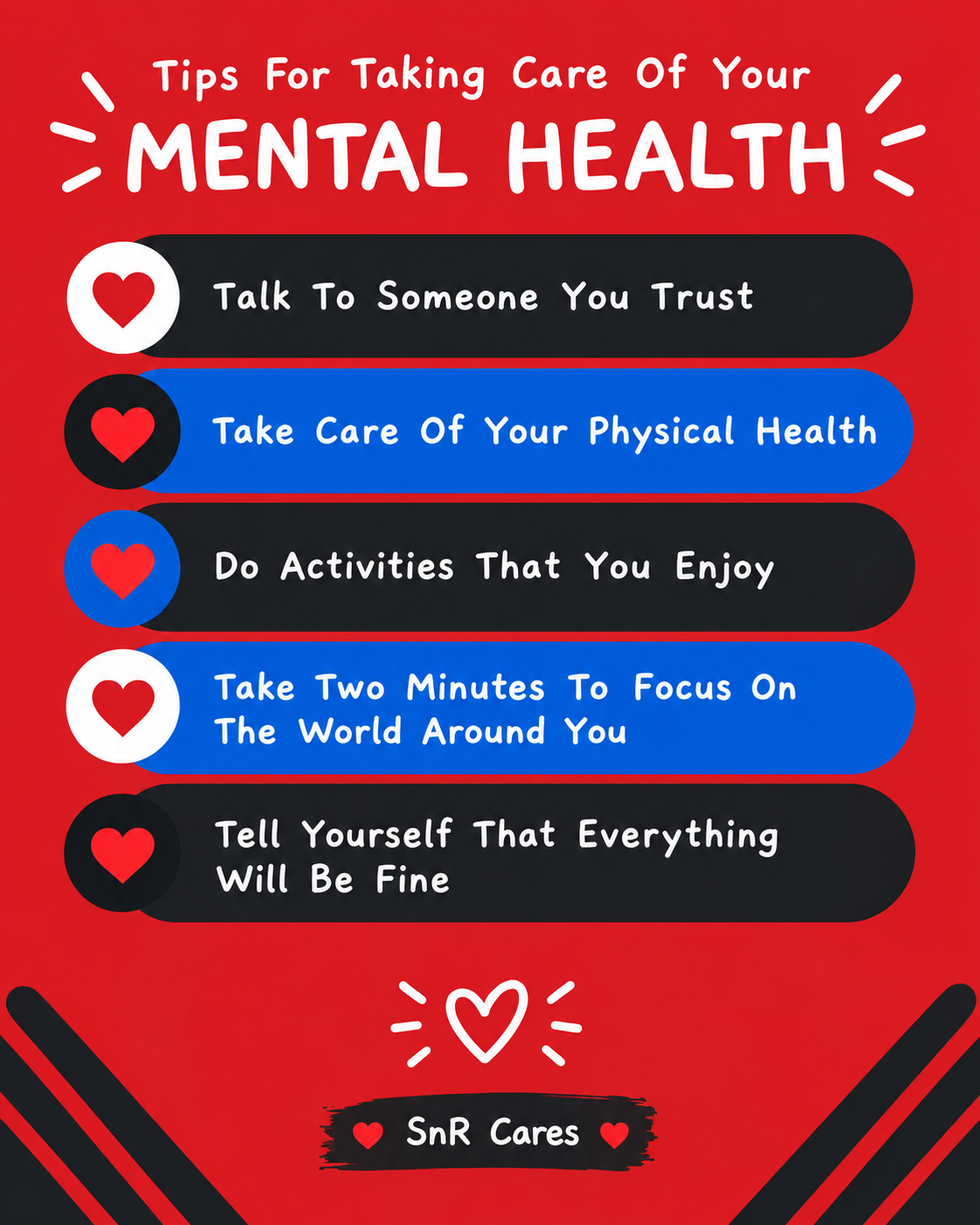
988 Suicide & Crisis Lifeline information · shared by SnR CaresSmall reminders about connection, everyday care and taking a moment.
These are general suggestions, not a promise that everything will be fine or a substitute for individual support.
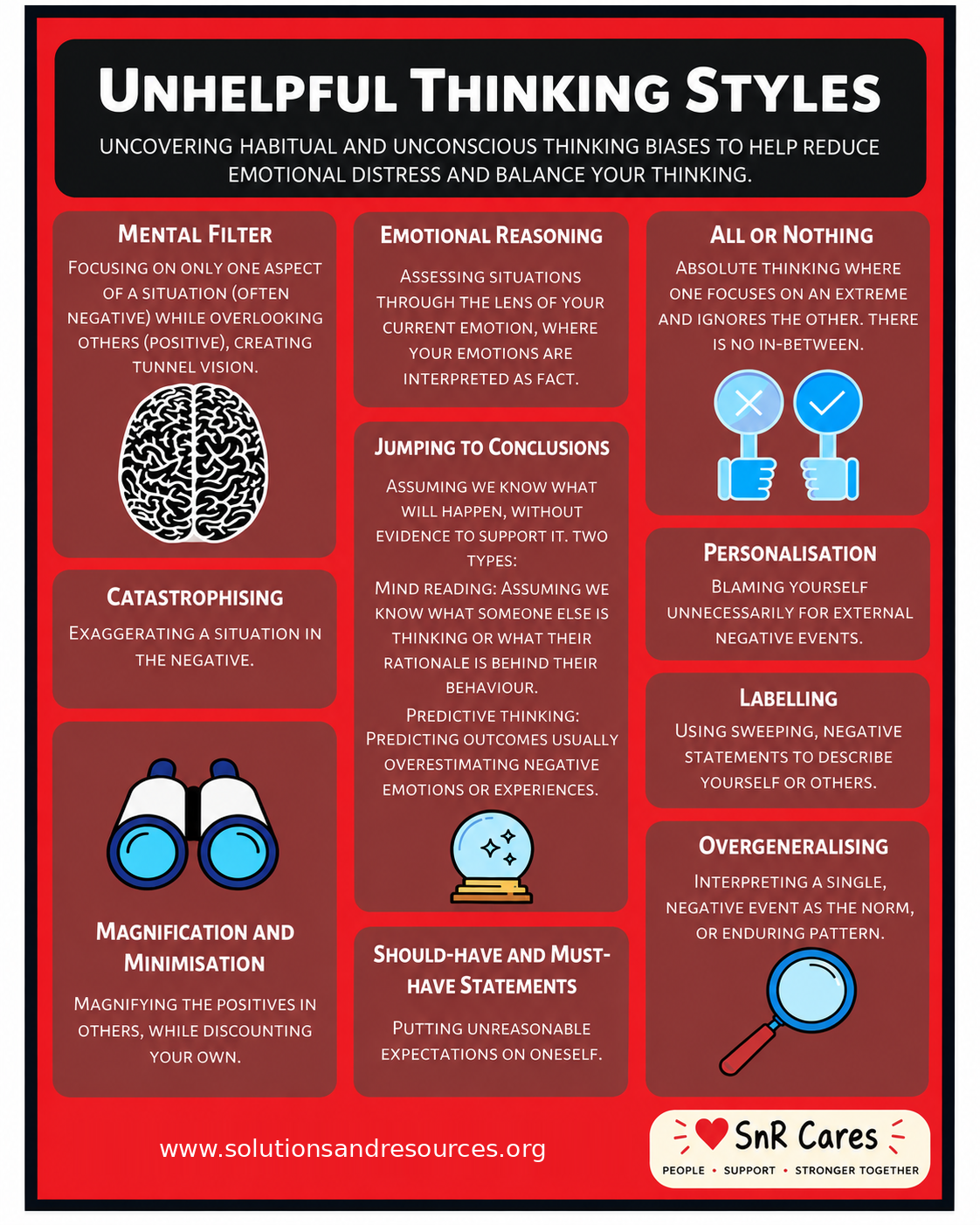
SnR Cares · adapted educational flyerA pause to notice patterns such as all-or-nothing thinking and jumping to conclusions.
This resource is educational, not a diagnosis or a requirement to change how you feel. The contact line uses the Solutions and Resources website.
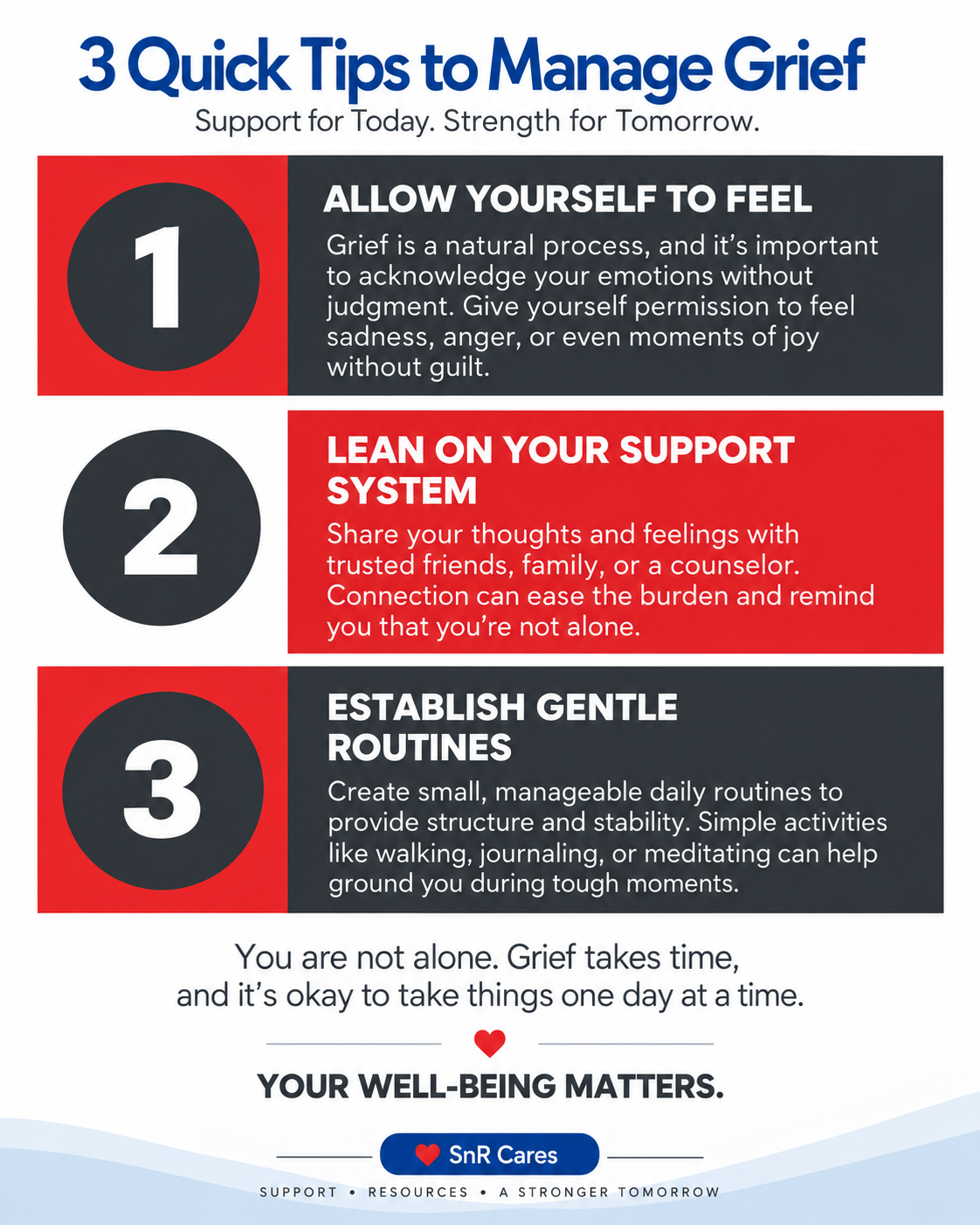
SnR Cares · adapted educational flyerAllow yourself to feel. Lean on support. Establish gentle routines.
There is no single timetable for grief. These are general reminders, not a prescribed recovery plan.
SnR Cares · adapted educational flyerShared with care by SnR. These four SnR Cares flyers are adapted educational resources, not a diagnosis, personalized treatment, or a guarantee of recovery.
The 988 Suicide & Crisis Lifeline is a separate national service, not an SnR-operated line. Use the written contact options and links provided here.